

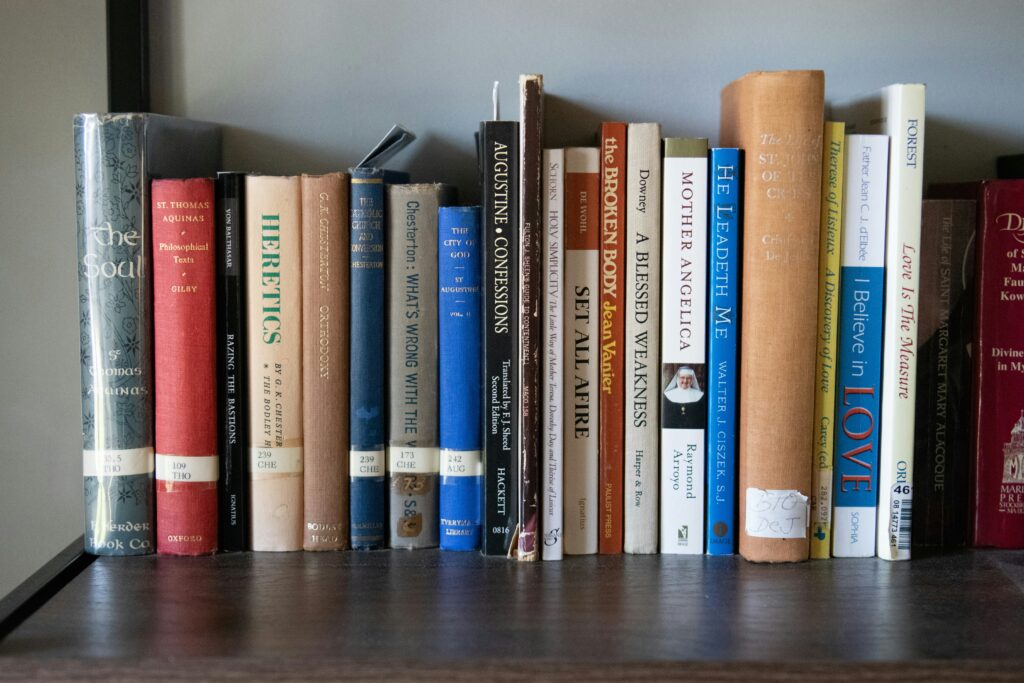
Every Christian needs a theological library.
Not just pastors. Not just seminary students. Every Christian who is serious about studying the word, reading good books, and growing in godliness.
So today I want to show you how to build one from the ground up in 7 practical steps — whether you’re starting from scratch or reorganising what you already have.
Let’s start with one overarching principle that shapes everything else.
The Governing Principle: Quality Over Quantity
You’ve probably seen pictures of a pastor’s or theologian’s library — floor-to-ceiling shelves packed with hundreds of volumes — and thought “I need that”.
Besides the fact that coveting another person’s library might be breaking the 10th commandment, more is not better.
As I say to my Homegrown Theologian students, too many books can lead to confusion, less actual study, and a lack of focus. A library that’s grown too fast is often one that never gets used.
Instead, focus on slow, intentional growth. I find this analogy helpful: treat your library like a theological garden. Add good books gradually as your means allows. Pull out the weeds every now and then to keep it clean. Let it grow organically over time.
With that principle in mind, let’s build.
The Three Tiers of a Theological Library
Before getting into the steps, it helps to understand how a good theological library is structured. I break it into three tiers:
Tier 1 — Foundations. Bibles, study Bibles, commentaries, creeds, confessions, reference materials, dictionaries. The tools you’ll always need and always return to. If you had nothing else, these are the books you’d keep.
Tier 2 — Essentials. Classic works that most if not all Christians should read at some point. Church fathers, Reformers, Puritans, church history volumes, systematic theologies, biblical theologies. These are the books that have shaped the church across centuries.
Tier 3 — Optionals. Books suited specifically to your own study goals, interests, and season of life. Certain niche theological topics, Christian living books, popular theology works you’re drawn to. Not everyone needs these — but you might.
Most of the following steps work through these tiers from the ground up.
Step 1: Start With the Foundations – Your Study Bible
The most important book in your library is a good study Bible.
Honestly, a good study Bible could be all you ever need. It contains commentary, maps, historical data, biblical context, book introductions, cross-references, indices, glossaries, and theological notes throughout the text. That’s an enormous amount of study material in a single volume.
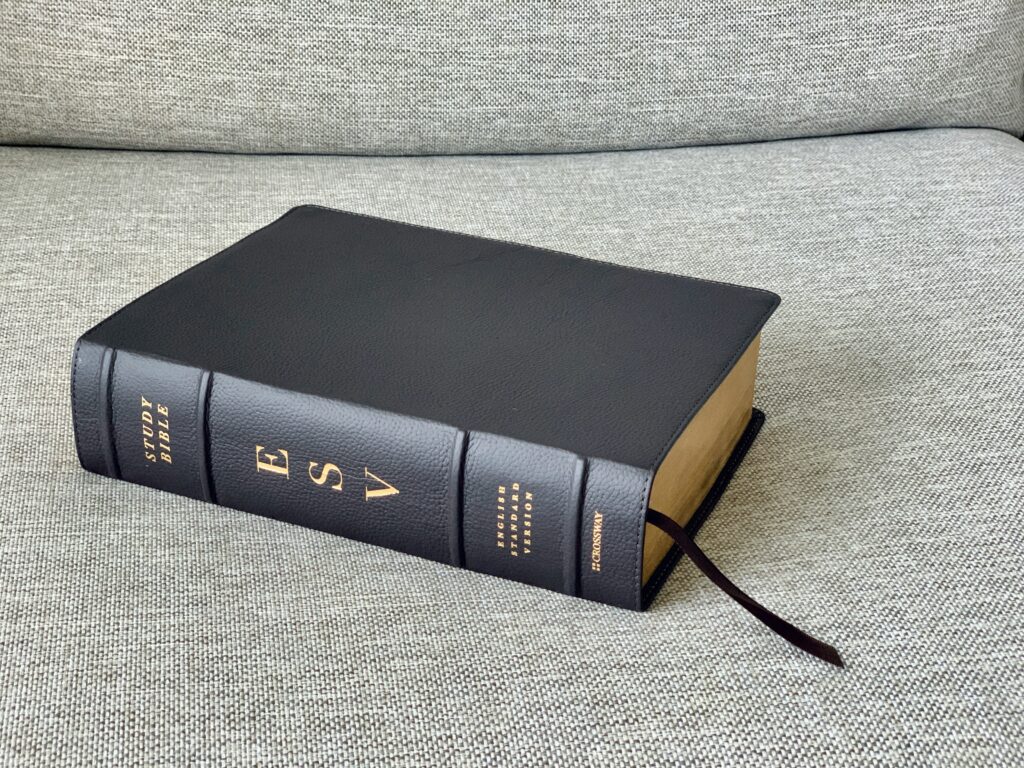
Which study Bible do I recommend?
As long as you’re in a solid translation — ESV, NKJV, KJV, LSB, NASB — you’re in good shape. My top picks:
- Reformation Study Bible (ESV) — My current go-to. Edited by R.C. Sproul, theologically rich, and packed with confessional notes. The NKJV version is unfortunately out of print, but the ESV edition is still available.
- ESV Study Bible — Excellent commentary notes, great study tools, and the ESV is one of the best translations available. I used this for years and still do.
- NKJV Study Bible — A solid option if you’re committed to the NKJV as your daily driver.
- Reformation Heritage KJV Study Bible — Edited by Joel Beeke. One of my Homegrown Theologian students uses this as his primary study Bible and loves it.
The key takeaway: pick one main study Bible and actually use it. Don’t feel like you need all of them immediately. Start with one, go deep with it, and expand from there.
Beyond your main study Bible, it’s worth having a few other translations on the shelf for cross-referencing. I keep an ESV, an old King James (my great-grandfather’s copy, with his handwritten notes I haven’t fully explored yet), and occasionally reference others.
But your daily driver — the one you read, study, and memorise from — should be one translation you stick with consistently.
Recommended: The 5 Best Bible Translations (That Are Reliable & Accurate)
Step 2: Strengthen the Foundations — Commentaries, Confessions & Reference Books
Once you have your study Bible, you need resources that put armour on your Bible study. The study Bible does the bulk of the work, but it’s not enough on its own.
Commentaries
Study Bible notes are helpful but limited — usually brief, basic observations. For deeper work on a passage, you need a proper commentary set.
I recommend starting with what I call the Reformed 3:
- Matthew Henry’s Complete Bible Commentary — The original, unedited version. It’s devotional, rich, and more readable than you’d expect for a 17th-century work. This is my go-to.
- John Calvin’s Commentaries — A full set is hard (and expensive) to get in print, but Kindle and online versions are free or very cheap.
- John Gill’s Exposition of the Bible — Same situation as Calvin on availability, but equally worth having access to.
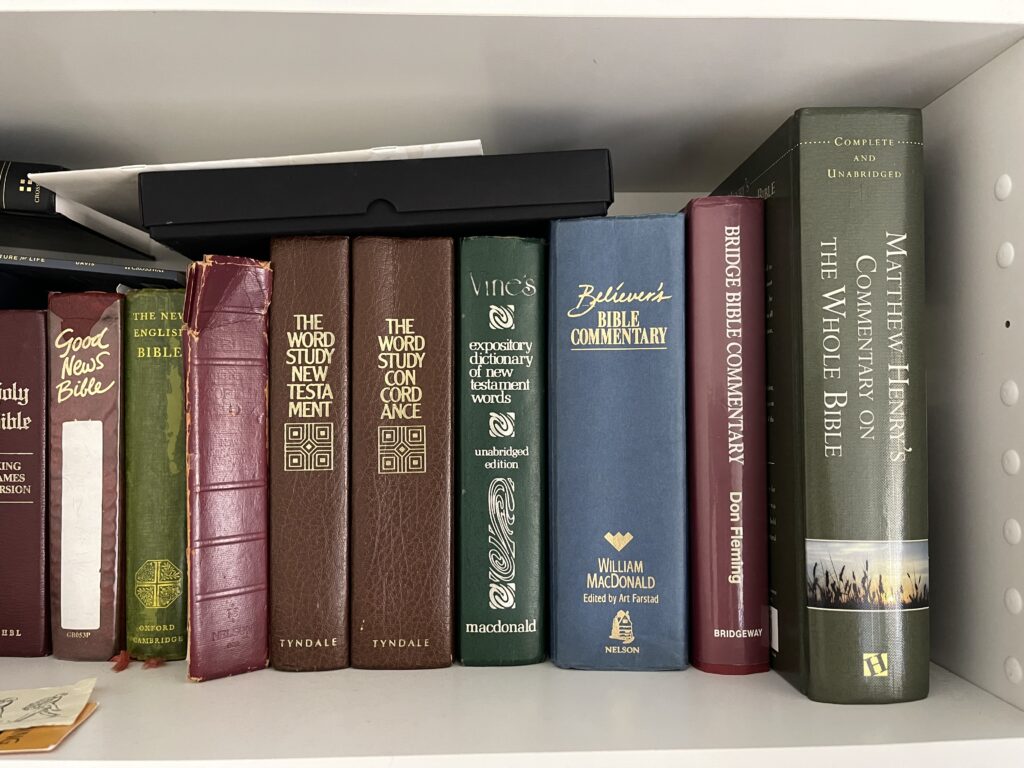
Matthew Poole and Charles Spurgeon are two others I’ll occasionally reference — Poole as a kind of forerunner to Matthew Henry, and Spurgeon for his sermon-based notes on specific passages.
For more modern commentaries, R.C. Sproul’s series is accessible and solid. Warren Wiersbe’s Be series is a great entry-level option — devotional in style, easy to read, and a good starting point for someone just building their library. I don’t agree with all of Wiersbe’s theology, but he’s a reliable Bible teacher overall. The MacArthur NT Commentary Set is another popular choice. One I haven’t had the chance to dig into yet but looks excellent: the ESV Expository Commentary series. If the ESV Study Bible is anything to judge by, it’s going to be outstanding.
The principle here is the same as with Bibles: don’t buy everything at once. Pick one classic set and one modern set, use them, and expand slowly.
Creeds, Confessions & Catechisms
If you’re a Reformed evangelical Protestant, access to the historic confessions is non-negotiable. These are not optional extras — they represent what Protestant churches have believed, confessed, and died for across centuries.
At minimum, you want:
- The Westminster Standards (Confession, Larger & Shorter Catechism)
- The Three Forms of Unity (Heidelberg, Belgic, Canons of Dort)
- The 1689 London Baptist Confession
- The ancient creeds (Apostles’, Nicene, Athanasian, Chalcedonian)
My Reformation Study Bible actually contains many of these — something I only fully appreciated recently. For an all-in-one physical volume, I recommend Chad Van Dixhoorn’s Creeds, Confessions, and Catechisms. For individual copies, the Founders Ministries 1689 in Modern English is what I use for both church and personal study.
Note: if you have a Reformation Study Bible from R.C. Sproul, you’ll find many of these at the back.
Reference Books
Most of your reference needs will be covered by your study Bible, but three tools are worth having beyond that: a lexicon, a Bible dictionary, and a concordance.
For those just starting out, the Blue Letter Bible app is genuinely excellent for this — it contains multiple dictionaries, lexicons, and concordances in one place, all free. I used it as my primary reference tool for years and still find it helpful.
That said, I’m gradually moving towards physical reference books for more serious study. The tools I’m working towards:
- BDAG — the standard Greek-English lexicon for the New Testament
- BDB (Brown-Driver-Briggs) — the standard Hebrew lexicon for the Old Testament
- Vine’s Expository Dictionary of New Testament Words — already on my shelf
- New Bible Dictionary — a solid all-round Bible dictionary I plan to add soon
- Strong’s Concordance — still useful for most readers for tracking word usage across the Testaments
Reference books can be expensive. If budget is a concern, the Blue Letter Bible smartphone app is a completely legitimate alternative while you build up to the physical versions.
Recommended: How to Read the Bible Properly – 7 Steps Christians Often Miss
Step 3: Pick Books You’ll Actually Read — Not Ones That Make You Look Smart
Once your Tier 1 foundations are in place, you’re free to start building out Tier 2 and Tier 3. But here the temptation changes.
The temptation at Tier 1 is under-buying. The temptation at Tier 2 and 3 is buying for appearances.
The heavy systematic theology you’ll never open, the academic commentary you bought because it looked impressive, the book someone famous recommended that has no bearing on where you actually are in your theological development.
Don’t do that.
Every book you add should pass two tests:
- Likelihood to read — Are you genuinely going to read this? Is it suited to your current reading ability? Are you excited about it? Is it relevant to a real goal or question in your life right now?
- Importance — Will this book develop you, challenge you, and build a solid theological foundation? Will it give you the kind of spiritual nourishment that lasts?
Ideally, every book you buy ticks both boxes. It’s important and you’re excited to read it.
One thing worth saying: more academic does not automatically mean better. People associate academic with important, but some popular-level books will outlast far more rigorous academic works. J.I. Packer’s Knowing God is the obvious example. At the same time, many popular-level books are weak rewrites of older, better works.
The sweet spot is semi-academic books that are still accessible to the average Christian reader — think R.C. Sproul’s Everyone’s a Theologian, Kim Riddlebarger’s A Case for Amillennialism, or Bruce Shelley’s Church History in Plain Language. Deep, well-researched, but readable.
Recommended: 15 Types of Books Every Christian Should Read
Step 4: Progressively Fill the Shelves With Older Books
As your library grows, lean towards older books.
Time-tested works enrich a library in ways that modern titles generally can’t. The older books in your Tier 2 list — the classic Reformers, church fathers, Puritans — are called essentials for a reason. They’ve shaped the church across generations and their wisdom hasn’t aged.
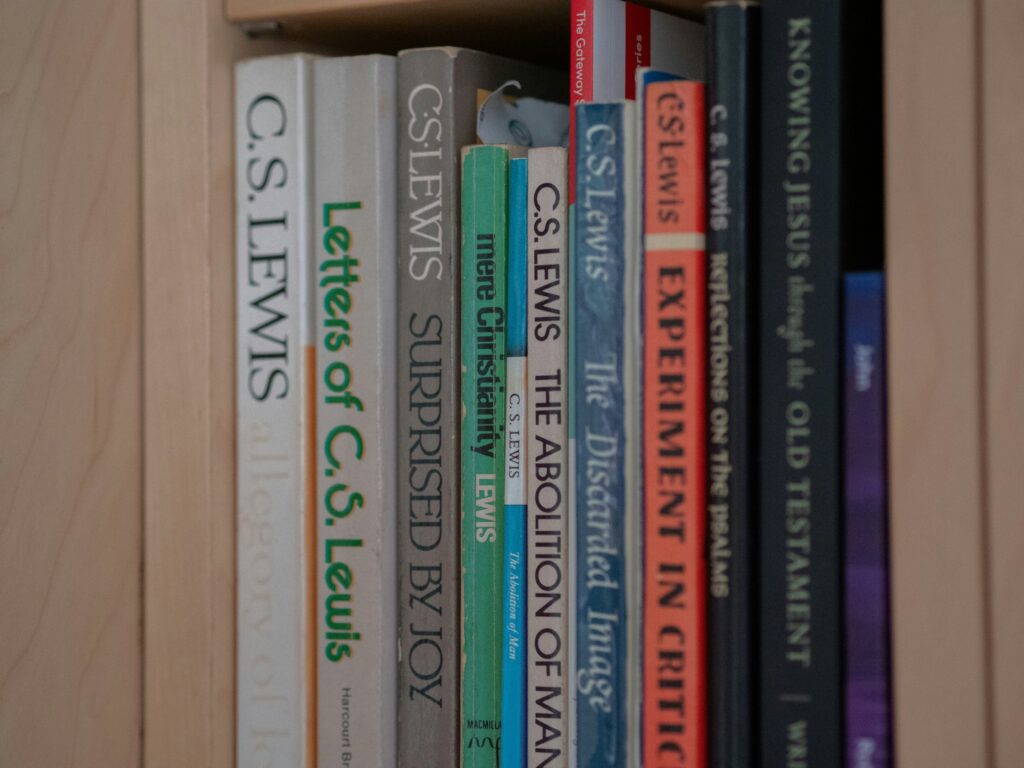
Now, if you’re still a relatively new theological reader, it’s completely fine to start with accessible modern authors — Sproul, Piper, Sinclair Ferguson, James White, Voddie Baucham. These are the on-ramp. Read them, build the habit, develop the theological vocabulary.
Then start moving towards the primary sources. Augustine. Calvin. Luther. Owen. Edwards. Athanasius. There is simply no modern summary of Calvin’s Institutes that replaces actually reading the Institutes.
A good spread to work towards across the fathers, Reformers, and Puritans:
- Augustine — Confessions
- Athanasius — On the Incarnation
- Calvin — Institutes of the Christian Religion (long, but worth it)
- Luther — The Bondage of the Will
- Richard Sibbes — The Bruised Reed
- Thomas Brooks — Precious Remedies Against Satan’s Devices
Recommended: 5 Entry-Level Puritan Books (Start Here If You’re New) | The Bruised Reed by Richard Sibbes Review
Step 5: Aim for Both Breadth and Depth Across Topics
A good library isn’t just deep in one area — it covers ground.
Within theology, you’ll naturally gravitate towards certain topics. That’s fine and expected. If pneumatology is where your heart is, maybe 30% of your theology shelf reflects that.
But you should also have systematic theologies, Christology, ecclesiology, covenant theology, church history, and popular-level works across different areas. Don’t let the library become lopsided.
I apply the 80/20 rule here: 80% of my reading comes from theology and the Bible. The remaining 20% is everything else — history, philosophy, fiction, vocational reading, books in the Western canon.
Why read outside theology at all? Three reasons. First, theology interacts with every discipline — history, philosophy, science, literature all touch on theological questions, and understanding them makes you a better theologian. Second, your personal study may involve other disciplines directly. Third — and this is underrated — it gives your mind a break. Everyone needs to read something different occasionally to stay fresh.
My own non-theology shelf includes fiction (old and modern), productivity books, and books from the Western literary canon — which I find more rewarding the longer I read, especially when Christian themes surface unexpectedly.
Recommended: How to Read Like a Reformed Christian: The 7 Pillars
Step 6: Ruthlessly Cut Bad or Unhelpful Books
This is the step most people avoid. And it’s why so many libraries are cluttered with books that haven’t been opened in a decade.
A large library is not automatically a good one. Constantly and diligently eliminate bad books. Make room for the right ones.

What counts as a bad book? Books:
- with poor or unbiblical theology
- that are weak re-packagings of earlier, better works
- you inherited or were given that don’t belong in a Reformed evangelical library
- you bought on impulse that you’ll never actually read
Most of us end up with these somehow. Maybe you inherited a library from a family member with mixed theology. Maybe you had a Goodwill shopping spree that got out of hand. Maybe you bought something based on hype that didn’t deliver.
Don’t let them sit there. Give them away. Sell the rare ones if they have value. Donate the rest.
A smaller, cleaner library will sharpen your study life considerably — and free up both shelf space and mental clarity for the books that actually deserve to be there.
Step 7: Always Keep a Want-to-Read List
The longer you study theology, the faster your reading list will grow. That’s a good thing. But it creates a real problem: impulse purchases.
The solution is a want-to-read list — a running record of books you’d like to read or buy at some point, kept somewhere you can actually refer to.
I use Goodreads. A physical notebook works. A note on your phone works. I have a a ‘want-to-read’ list template inside my Homegrown Theologian program. The format doesn’t matter. What matters is having the list and consulting it before you buy.
When a book catches your eye, add it to the list rather than buying it immediately. Then sit on it. Sometimes a month later you’re just as excited and you buy it.
Other times, what looked compelling turns out to have been marketing hype and the interest fades on its own. The list acts as a filter, letting only the books you genuinely want through.
This saves money. It saves shelf space. And it keeps the standard of your library high, because you’re not letting books in on impulse — only on considered judgement.
Recommended: How To Study Theology (Without Seminary): The 5-Step Guide
Final Word
A quality theological library doesn’t happen overnight. It’s built slowly, intentionally, and with a clear sense of what belongs.
To summarise the seven steps:
- Start with the foundations — get a solid study Bible first
- Strengthen the foundations — add commentaries, confessions, and reference tools
- Pick books you’ll actually read — importance and excitement, not appearances
- Fill the shelves with older books — lean towards time-tested primary sources
- Aim for breadth and depth — cover the theological landscape, and read outside theology too
- Ruthlessly cut bad books — fewer, better books beats more, mediocre ones
- Keep a want-to-read list — filter impulse purchases and maintain your standard
Build it slowly. Keep it clean. Let it serve you for decades.
That’s a library worth having.
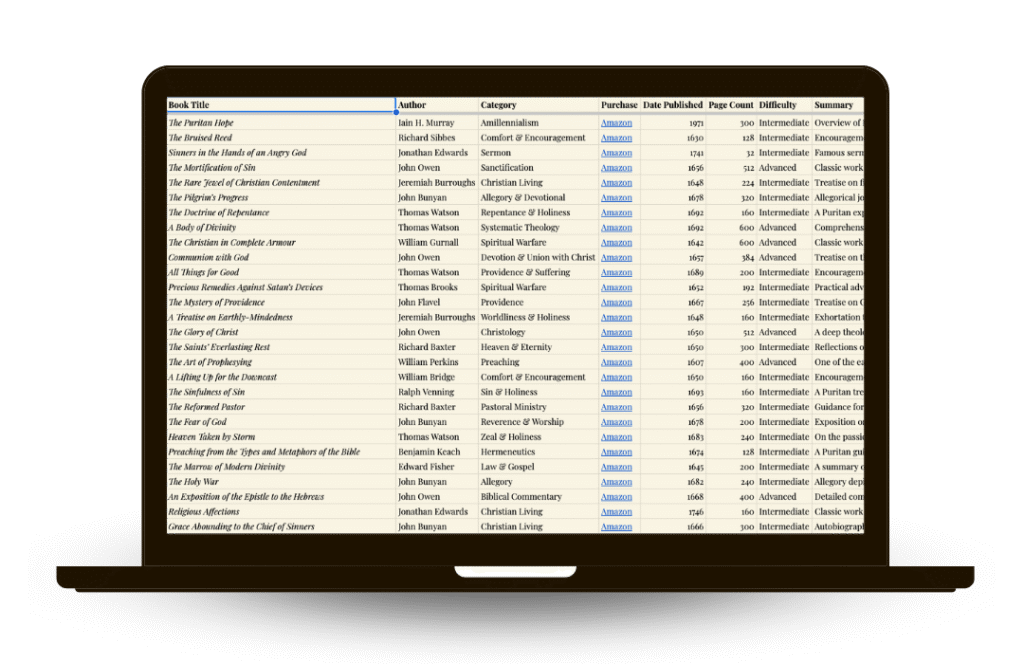
Want a head start on filling those shelves? Grab my free Ultimate Reformed Book List — over 400 curated titles across 25+ categories, with summaries, difficulty ratings, and page counts.
