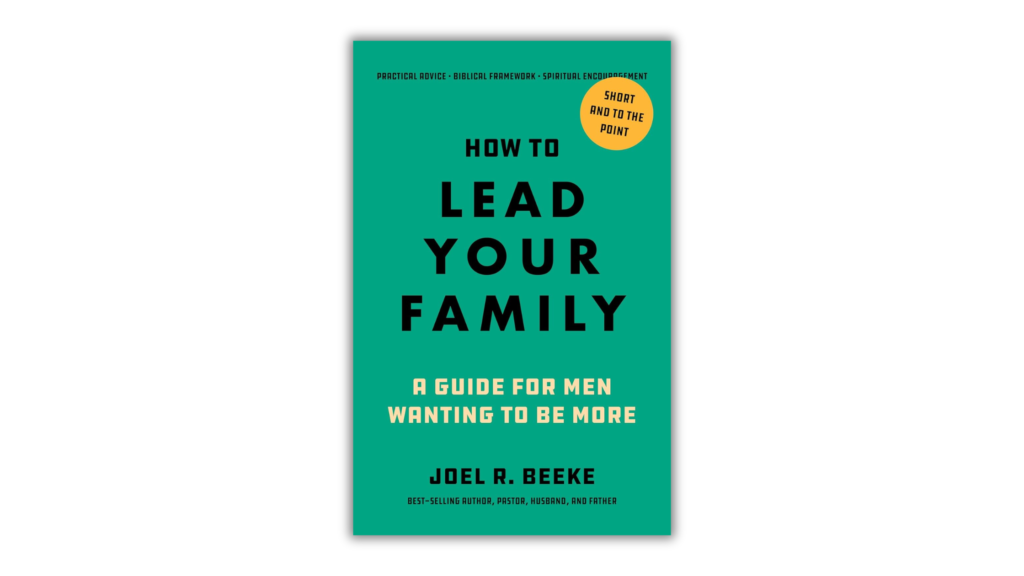
For years, I’ve been looking for a short, accessible, and theologically rich book that I can recommend to husbands, fathers, and men who desire to become both.
Most books don’t tick all three of those boxes. At least until How to Lead Your Family by Joel Beeke came along.
I’ve been considering adding this to the Masculinity 101 module in my Homegrown Theologian program – and after reading it, I think it deserves a proper review.
So today I’m walking you through five things I really benefited from in the book, including something in Point 4 that most popular-level theology books simply don’t have.
Here’s what we’ll cover:
Why the book’s structure makes it accessible to almost anyone
Beeke’s Biblical (not nostalgic) vision for male leadership
The three-fold office framework and what it means for husbands
The story of James Payton — and why it alone is worth the price of the book
Why the study questions actually challenge you
How the book tackles real, modern problems head-on
Minor criticisms and final verdict
Let’s dive in.
Want my hand-crafted list of 400+ Reformed & theology books for free?
Formatted with title, author, subcategory, publish date, page numbers and purchase links
How to Lead Your Family is written mainly for husbands and fathers – or men who want to become both. But honestly, any Christian man who wants to understand God’s design for male leadership in the home will benefit.
It’s also a great book to hand to a new husband, a young man approaching marriage, or someone who has been a husband for years but has never really thought carefully about what biblical leadership actually looks like.
Here are 6 things to note about the book:
1. Pretty Much Anyone Can Read This Book
The first thing worth saying: this is an 80-page book. Essentially a booklet.
It’s broken into five chapters — an intro, three body chapters, and an outro — with a few appendices at the back for further reading. Short, structured, and to the point.
There is no excuse not to read this. If you’re the kind of person who feels intimidated by theology books, this is the place to start. You’ll get genuine theological substance without the 400-page commitment.
I’ve added it to my Ultimate Reformed Book List — my one-stop shop of quality theological literature broken down by category, difficulty, and page count. Go grab that for free above if you haven’t already.
2. A Biblical Vision for Male Leadership (Not a Nostalgic One)
This is an important distinction that Beeke handles better than most.
As a culture prone to nostalgia, it’s easy to look back at the most recent “good example” of male family leadership in history and assume that’s the biblical standard. For a lot of people, that means the 1950s.
I’ll be honest — earlier in my marriage, my wife and I fell into that exact trap when we first discovered God’s design for gender and marriage.
Don’t get me wrong – there are good things in the ’50s worth recovering. But 1950s ≠ biblical marriage.
Beeke addresses this directly in the opening of the book:
“We live in an age of rampant divorce, sexual promiscuity, fatherlessness, homosexuality, transgenderism, immodesty, and pornography. We need God’s refreshing, beautiful, and life-giving design for our family life… our tendency to idealize the past is foolish. Such nostalgia is precisely what Solomon warns against in Ecclesiastes 7:10.”
He goes on to point out that while families in mid-20th century America weren’t facing today’s battles around gender ideology, they had their own serious problems — rampant domestic abuse, actual (not pretend) racial segregation, and unbiblical family dynamics that people simply didn’t talk about.
That’s a balanced, honest picture. And it sets the tone for the rest of the book: we go to Scripture for our vision of the family, not to any particular era of history.
3. Prophet, Priest, and King – With One Section That Stands Out
The theological framework Beeke uses to structure the husband’s role isn’t entirely unique to this book.
Samuel Waldron does something similar in A Man as Priest in His Home, applying Christ’s three-fold office of prophet, priest, and king to the husband’s leadership role in the family.
But what Beeke does particularly well is do it succinctly — and that matters for a book of this length.
Here’s the basic framework in brief:
The Prophetic Office — teaching your family Scripture and how to live in the world
The Priestly Office — sacrificing yourself for your wife and children
The Kingly Office — leading and disciplining your wife and children
The section I found most striking was on the priestly office. Beeke writes:
“Christ’s sacrifice aimed at purifying our lives from sin so that we would be holy for him… In the same way, love your wives with the priestly goal of making them holy to the Lord.”
This is the idea that we are to be instruments of our wives’ sanctification — not that we do the sanctifying work (that’s the Holy Spirit), but that God has placed us in a position to wash our wives with the word, mirroring what Christ does for His church. That’s a high and humbling calling.
Want my hand-crafted list of 400+ Reformed & theology books for free?
Formatted with title, author, subcategory, publish date, page numbers and purchase links
This was one of my favourite parts of the book — and honestly, I’d buy the book for this story alone.
Many Christian men lack real role models as husbands and fathers. Beeke addresses this in both the introduction and the outro through the true story of James Payton, a Scottish shopkeeper whose son John went on to become a theologian and missionary.
Here’s the passage from the book:
“James Payton worked in a shop in the family home in Scotland. James’s children remembered his fervent prayers for them before the throne of grace. He used a small room in the house as a prayer closet, and his regular visits to it deeply affected his son. John later wrote: ‘Thither daily and often times a day, generally after each meal, we saw our father retire and shut the door, and we children got to understand that prayers were being poured out there for us.'”
And then this, when John left home to study theology in Glasgow:
“…his father walked with him the first six of the forty miles to the nearest train station. As they walked, they spoke sweetly about the Lord, and James gave godly counsel to his son. They walked without a word for the last half mile, but James’s lips moved silently in prayer for his son while tears streamed down his face. When they parted, James grasped his son, saying: ‘God bless you, my son! May your father’s God prosper you and keep you from all evil.'”
John Payton later recorded that as he walked the rest of the way alone, he vowed never to grieve or dishonour such a father and mother as God had given him.
What a picture. A father who prayed daily — at every meal. A son who witnessed it, was shaped by it, and carried it with him into a life of gospel ministry.
And if you look closely, all three offices come through in this one story. The priestly office in James’s intercession for his family. The kingly office in carving out consistent, disciplined time for prayer. The prophetic office in the counsel he spoke over his son on that walk.
Beeke couldn’t have chosen a better illustration to anchor the whole book.
5. The Study Questions Are Actually Good
This is the thing that most popular-level theology books lack — and it’s the reason I wanted to highlight it.
You’ve been in a Bible study. You know what token study questions look like. Tick-the-box questions. Generic prompts with obvious answers. Questions that require no real self-examination.
These aren’t those.
Here are three examples that genuinely challenged me:
From the introduction chapter: “How is the attack on the family an attack on the authority of Scripture?”
From the chapter on a prophet in the home: “Using Bible tools like a concordance or commentary, explain the following concepts from Ephesians 6:4. Then identify where you must repent in your leadership: provoking children to wrath, bringing up children, nurture, admonition.”
From the chapter on a king in the home: “Why is spiritual intimacy the most important aspect of marital intimacy?”
That last one especially — you might instinctively say “yes, of course marriage is primarily spiritual.” But why? What are the implications of that? The question forces you to actually work it out rather than nod along.
These questions are worth sitting with. Don’t skip them.
6. It Engages With Modern Problems Head-On
This is the third box the book ticks that most similar books miss. It is theologically rich and practically applied to the real challenges modern husbands and fathers face.
Beeke doesn’t stay at 30,000 feet. He gets specific:
Physical training and sports. He affirms the value of sport — team building, responsibility, physical development — but warns against buying into the world’s obsession with sports culture, which can easily consume your whole family.
Electronic media. He addresses guarding your children against illicit online material and fake online relationships that draw them away from real-world connection. This is a husband’s responsibility.
Romance and opposite-sex relationships. It’s your duty as a father to defend your children against the idea that dating is purely recreational, or that opposite-sex friendships carry no different dynamic than same-sex ones. The dangers are real.
Unjust authorities. Whether it’s a school, a government organization, or any institution that seeks to oppress or mislead your children — you are called to stand up and lead. I’d extend this to your wife as well. Defend those in your care.
It’s rare to find a book this theologically grounded that is also this willing to name specific, contemporary scenarios. Beeke does both without sacrificing one for the other.
Minor Criticisms
In the interest of honesty: a book this short will inevitably leave ground uncovered. That’s not really a criticism — it’s just the nature of an 80-page work. You may finish it wanting to go deeper, and you should. My Ultimate Reformed Book List has plenty of options to take you further (sign up below).
If I’m being genuinely nitpick-y: I would have loved more examples from Beeke’s personal life and from the lives of people he has known. The James Payton story was excellent, but I felt the lack of it in some of the other chapters. Showing how these three offices have actually been lived out — in his own marriage, his own home — would have added more ‘warmth’.
I’d also have welcomed more on the specific challenges of male and female sin patterns — the particular temptations husbands struggle with, and how to lead your wife through hers. That feels like a natural place for a book like this to go, and it doesn’t quite get there.
But these are minor things. The length demands that sacrifices be made, and Beeke makes the right ones.
The Final Word
How to Lead Your Family is the book I’ve been waiting for on this topic. Short enough for any man to actually read. Theologically grounded without being academic. Practically applied without being shallow. And honest about the cultural moment we’re actually living in rather than the one we wish we were.
Rating: 9/10
If you are a husband, a father, or a man who intends to be either — read this book. It won’t take you long. And it will challenge you in the right ways.
Want hundreds more books like this one, organized by category, difficulty, and page count? Grab my free Ultimate Reformed Book List below.
Want my hand-crafted list of 400+ Reformed & theology books for free?
Formatted with title, author, subcategory, publish date, page numbers and purchase links